
Misremembering the West
Conservatives in the US and across the West wish for a return to Christendom, but in doing so they imagine the Western past as singular when it is in fact radically plural.

Towards the end of a fascinating two weeks in the United States I met with the Roman Catholic theologian Cyril O’Regan, one of the most incisive thinkers in theology today. Over breakfast at the University of Notre Dame, where I was briefly a faculty member in Peace Studies, I was grateful to hear his insights into how we understand the apocalyptic and the efforts of various theologians to explore it. O’Regan kindly gave me a signed copy of the first volume of his Anatomy of Misremembering where, via Hans Ur Von Balthasar, he takes issue with the “simulacrum of genuine Christianity” that is found in modernity, tying this to the highly sophisticated amnesia offered by the towering modern philosopher Georg Hegel. To misremember is not merely to forget but to, wittingly or unwittingly, construct a partial account of the past where actual complexity is simplified into a certain narrative.
Misremembering is not just a matter of philosophy but, as O’Regan fully understands, has suffused into contemporary culture to a degree that it appears hard for us moderns to remember anything beyond the personal and immediate. Modern America is surely a society shaped by competing simulations of reality, particularly in its divisive political discourses. These discourses are simulations in that while they connote “evidence” to support their beliefs their communication is entirely detached from the search for truth - while simultaneously asserting theirs is the only truth. Fox News, Truth Social, and similar media exist to propagate a certain misremembered conservative or nationalist “truth” against a misremembered liberal or internationalist “lie”. On the Left, there are similar misrememberings but they are presently less prominent and, I would argue, less detached from reality.
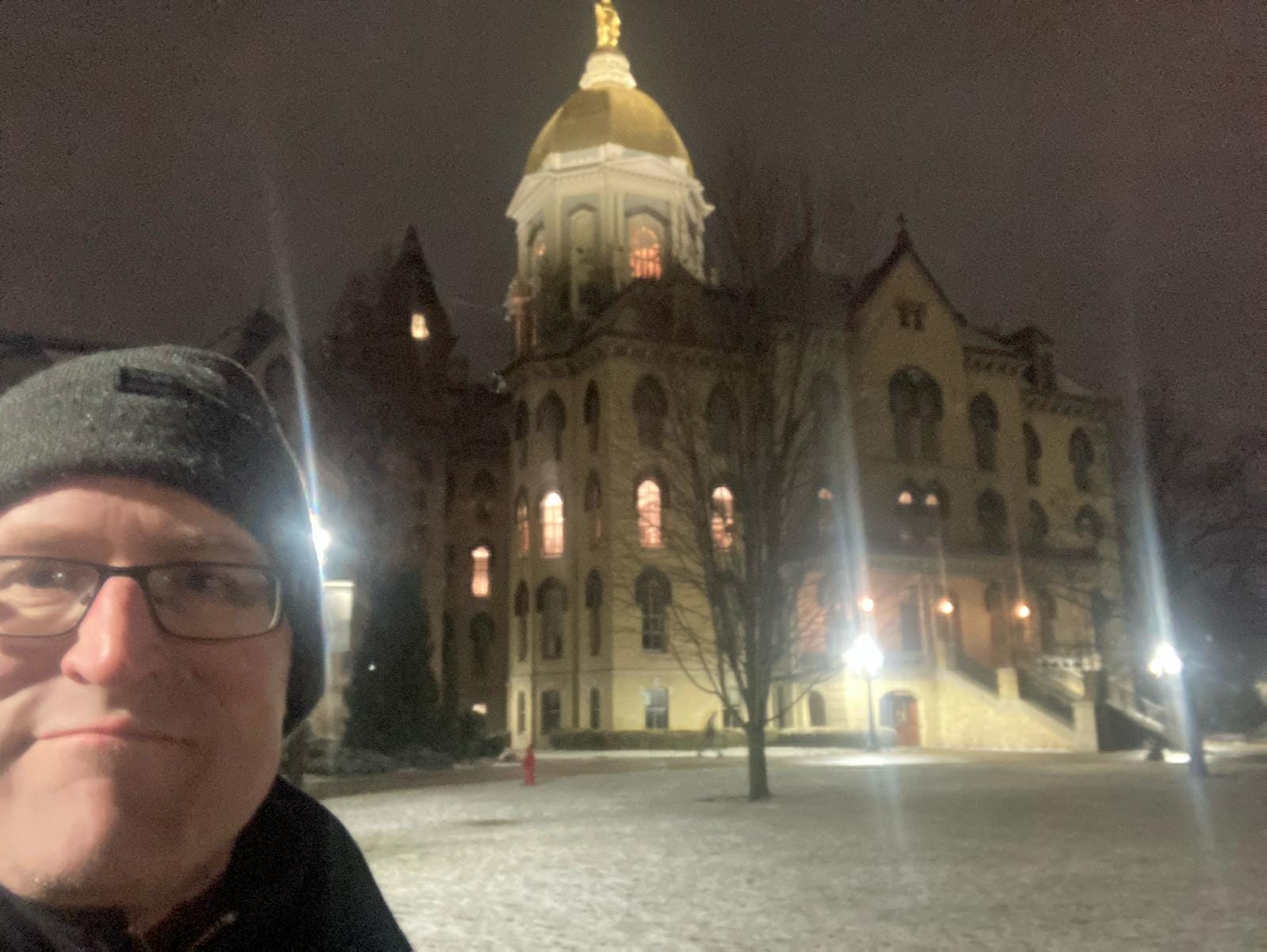
Above: Visiting the University of Notre Dame duirng late-winter snow, March 2025
The specific ways in which America is misremembered are quite familiar. Its rise is cast as a pristine White-European project when it has, in fact, always been diverse and multicultural, and also colonizing of native and other peoples. Its growth is presented as controlled and national when it was often chaotic with near-open borders and undocumented migration. Its strength is portrayed as that of a singular and conservative set of values when, again, the US has always been characterized by a cacophony of voices. Its weaknesses are found in socialism and multiculturalism; DEI is presented as entirely discontinuous from the country’s rugged individualism rather than a problematic and bureaucratic recasting of of America’s tradition of valuing diversity. This type of misremembering takes the exclusively male and, until recently, entirely White and largely Protestant class of founding fathers and presidents and assumes that they made America, rather than the people in all their plurality and inconsistency. For a populist discourse it is remarkably elitist.
It is the ways that Christianity is misremembered that most concerns me. For professed believers like JD Vance to “cultural Christians” like Douglas Murry and even Richard Dawkins alike, something like the 1950s version of Christian cultural domination and the peak of Western civilization are combined and assumed to be both mutually inclusive and eminently recoverable. The “woke” period which follows from the 1960s on is seen as a dramatic break. This is rather like claiming that rock and roll is discontinuous from gospel and country music; or that post-war democratic socialism is entirely detached from early twentieth century Christian socialism. More acutely, it is like seeing an opposition between Christ to Paul or, perhaps, the old covenant and the new. There is sadly a long history of this kind of late-modern misremembering by Western Christians. But for conservatives to presume revolution rather than (admittedly inconsistent and complex) evolution is to betray their profound amnesia.
It is not just America where Christianity is misremembered. Just before I went to the United States, the Alliance for Responsible Citizenship (ARC), held its second conference in the UK. ARC (like ark – geddit?) proposes to rescue Western civilization from its decline via a return to its Judeo-Christian roots. It attracted popular conservative commentators and erstwhile academics (Jordan Peterson, Nial Ferguson, etc), political party leaders (Nigel Farage, Kemi Badenoch) and Christian public figures (its co-founder Philippa Stroud, Miriam Cates, and Amy Orr-Ewing among others). There were many claims made by this panoply of figures. But there appears to be one categorical error which they all make to a greater or lesser degree: to misremember Western civilization as singular. Ironically, for this motley crew of diverse thinkers, “the West” is one rather than many contending voices. Even thoughtful Christians which have engaged critically with ARC – such as the Cross Section team at the UK’s Evangelical Alliance – risk repeating its categorical error of considering the West as singular and exclusive.
We can remember better. While driving across the vast expanses of the Midwest I was finally able to listen to most of Tom Holland’s Dominion, a popular book which avoids ARC’s error while extolling the extant importance of Christianity in the present Western context. For Holland (and, frankly, all serious historians and theologians), Western Christianity’s genius is in its pluralism – its reworking of the resources of other cultures, especially those Judaism, Islam and the Greeks, such as Aristotelian and Platonic ideas. By any fair reading, Christendom was both imperial and emancipatory, patriarchal and empowering of women, violent and peace-loving. It provides the cultural context for liberal democracy, human rights, and the ending of slavery. But it was also sadly, a go-to resource for conservative autocrats, torturers, and slave owners. The right response today is not to claim that Christianity’s legacy was of a uniform and particular kind but to recognize it polyvalence and inconsistencies. From this starting point, we may seek to support and sustain those practices which are most faithful to Christ’s vision of the new heaven and the new earth – and discard the others. But we should not forget any of them.
Here, we find a problem for all Christian civilizationists, many of whom subscribe to dominionism. Christ did not imagine that the Kingdom of Heaven would be advanced in government from the top but in the transformation of persons and, by extension, cultures, economies, and politics from below. In an age where the apocalyptic form of history is more pronounced, realistic political hope is found beyond government. This does not mean that Christians should disregard government, but they should not seek the kind of power that government offers and which flatters to deceive itself. The practices that should be discarded are those of the civilizationists, especially where they verge on political idolatry. The “world upside down” (Acts 17:6) is one where the power of the church in culture is shown to be far greater than the power of any one system of rule. Today’s dominionists in America and of the ARC, ought to read Dominion. Otherwise, they will continue to misremember the West.