
Jesus the Refugee
Prayerfully consider is Jesus really welcome at our carol services and gatherings this Christmas?…when he comes in the guise of a stranger, a refugee, undocumented? If not, how can we make it so?

This is a guest post - which first appeared on the site of the Centre for the Study of Bible and Violence - by Rachael Bee who has long hosted and worked with refugees in Bristol, UK. I have previously written about our project in Exeter and will host a blog from our project leader in the new year. Projects like these are important because they express Christ’s love for the poor. To me, they seem to mirror Christ answer when the lawyer asked him “Who Is My Neighbour?” (Luke 10:29). Theologically, they are also important as they constitute the church as a new political community - borderless, inclusive, abundant, protective - which inaugurates the eschatological reality of the Kingdom of God. Rachael’s post shows how the Kingdom grows not by simply welcoming the stranger but by making our ecclesial circles those that include both refugees and self-styled “patriots”. If patriotism is simply care for those who are our neighbours, who are of our true country, then it is patriotic to care for refugees. To illustrate her text, I repost Andrew Gadd’s wonderful Bus Stop Nativity too. I hope you find the peace and joy of Christmas. See you in 2026!
JH
Jesus the Refugee
By Rachael Bee
Over the past 17 years I have had the wonderful privilege of welcoming over 40 refugees and refused asylum seekers to live in my home. Some stayed a few weeks, most stayed a few months, some stayed for years. I have also had the great joy of co-founding and then leading two fantastic organisations supporting refugees (Refugee Welcome Homes) and destitute refused asylum seekers (Bristol Hospitality Network). Recently I also co-founded a new organisation Sanctuary Community Holidays linking rural areas with a heart for refugees with urban projects to run group holidays for asylum seekers and refugees. Over the past 15 years I have witnessed an extraordinary move of God among refugee people, particularly from Persia, and our little church is over 50% refugees and asylum seekers. We have learnt to sing Farsi worship songs, have amazing cooked meals for the whole church made by refugee members, introducing their culture and hospitality to us and we’re learning a lot about the foibles of English and Iranian culture as we navigate family together. It has changed everything for us. A gentle and slightly unsure ‘yes’ to Jesus in welcoming the stranger has resulted in extraordinary beauty and the combining of two cultures in a very Jesus way!
In the course of my work and at church I have met a wild array of different people from different countries, religions and backgrounds. Each of them has a compelling story to tell. Each of them, if I let them, has taught me about welcoming Jesus.
So who is Jesus the refugee? Well, you know the story; the young Holy Family are internally displaced people because of a forced census by an occupying power. Mary gives birth in poverty, an unwelcome guest. Some time after they are visited by Magi from another land with stories of portents in the sky and their baby called the new King and the next day they are hunted, as all who defy the powers are hunted, and barely escape with their lives, carrying only what they could grab in that moment of fear in the dark. They cross borders silently, keep their heads down in their new land, and long for home, but it is, as Warsan Shire the Somali poet says in her extraordinary poem ‘Home’; ‘the mouth of a shark’. Much later once the powers that wanted them dead are dead, they return home, the hope of every refugee. So yes, Jesus was a refugee and if we welcome refugees and asylum seekers, we welcome him.
The Bible is full of references to how God calls us to welcome the ‘alien and the stranger’; that’s asylum seekers and refugees in today’s world! Listen again to the words of Jesus in Matthew 25:34-40 (NIV)
Then the King will say to those on his right, ‘Come, you who are blessed by my Father; take your inheritance, the kingdom prepared for you since the creation of the world. For I was hungry and you gave me something to eat, I was thirsty and you gave me something to drink, I was a stranger and you invited me in, I needed clothes and you clothed me, I was sick and you looked after me, I was in prison and you came to visit me’. Then the righteous will answer him,
‘Lord, when did we see you hungry and feed you…The King will reply, ‘Truly I tell you, whatever you did for one of the least of these brothers and sisters of mine, you did for me.’’
Or in Leviticus 19: 34 (NIV)
The foreigner residing among you must be treated as your native born. Love them as yourself, for you were foreigners in Egypt. I am the LORD your God.
The treatment of the ‘alien and the stranger’ is a central part of the ethic of the Old Testament. They sit alongside widows and orphans, as people not just to tolerate, but to embrace, to love exactly the same as our native born.
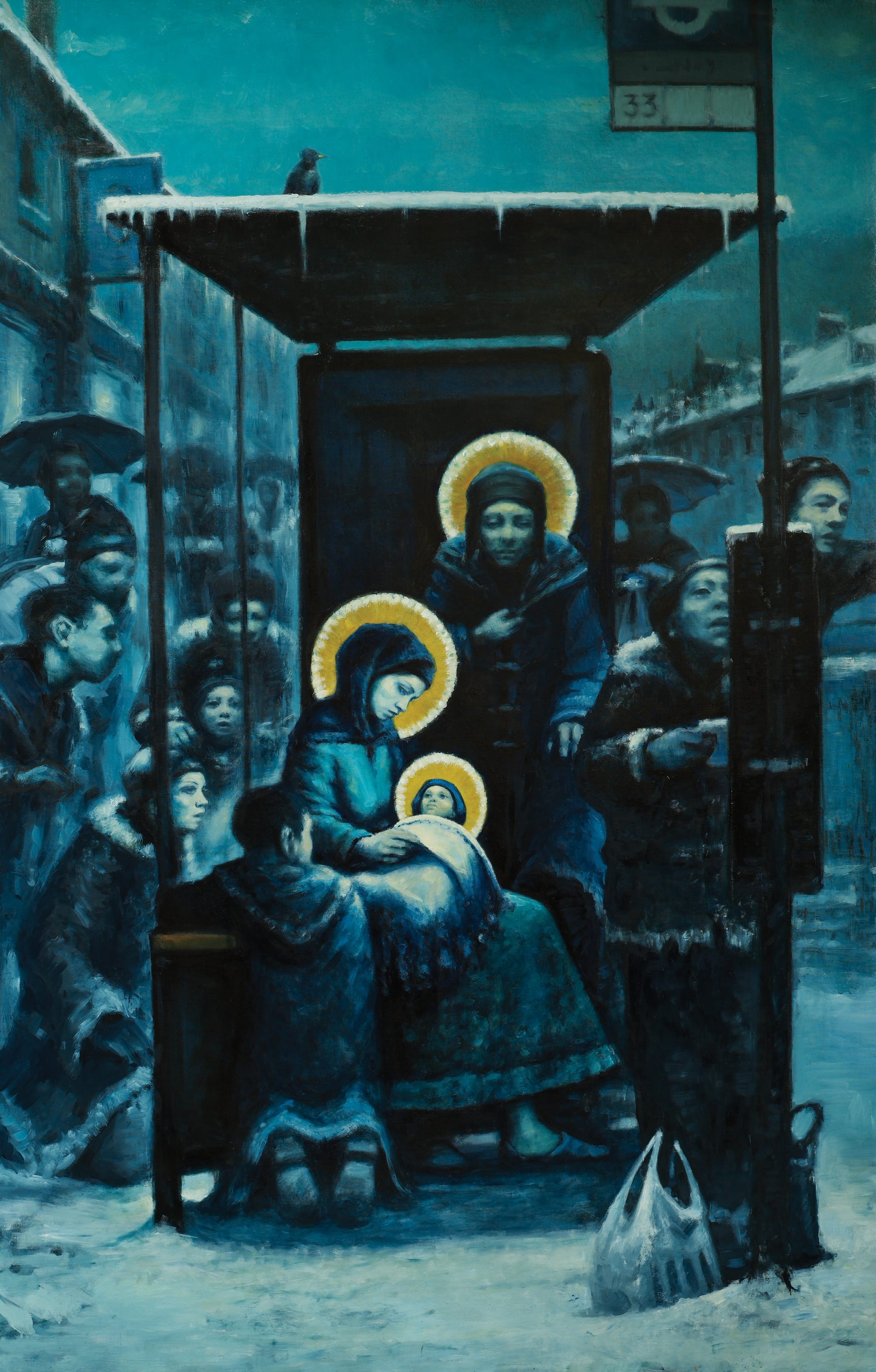
Bus Stop Nativity - Credit: Andrew Gadd / CofE
This has to profoundly change our perception if even a small part of us thinks of asylum seekers and refugees as a ‘problem to be solved’ in the UK. They are a gift, the most beautiful gift of all: Jesus in the guise of a stranger.
I will tell you two stories to illustrate this point. The first was when I was in labour with my son. I was feeling strangely calm so I sent my husband into work that day. At the same time, we were hosting a young guy from Palestine and he noticed me wandering the house in my fluffy pink dressing gown and breathing somewhat deeply (!), and asked me if I was ok. I replied that I was in labour and he responded by popping to the shop and cooking me a beautiful stew of lamb, staying with me all day while my husband was at work and basically keeping me calm through my labour until my husband returned. He was an unorthodox but great help. The second was very recently when our refugee lodger noticed I was sick with a fever and sore throat and just cooked me an amazing broth. I got better the next day. Clearly I have a food love language!
I tell these stories to put a human face to the statistics and fearmongering that we are regularly presented with. Depending on what you’ve liked on socials or what you’ve delved into on the internet, the algorithm is feeding you stuff it thinks you want to hear. This is driving us apart and putting Christians in two camps: totally counter to the way of Christ. But I believe the place of the church is to be the place of meeting, of real encounter; the loving embrace of (whom we perceive as) friend and foe alike. It must be the place where we grow to be more like Jesus by loving our enemies, giving away rather than accumulating worldly wealth, and loving the asylum seeker as our native born. The Bible was written in the time before the Refugee Convention (1951); the legislation that has saved millions of lives across the world. What is our refugee convention as followers of Jesus? Is it not to welcome the stranger, to love them as our native born. We are called to a higher standard than the world in this, and we are falling for the ways of the world.
Now is not the time for silence, but for conversations, difficult and mind bending conversations with people of difference. It is not the time for genteel English quietness but for a robust theological defence of the Biblical command to welcome the refugee. May our churches again be places of sanctuary, practical sanctuary against forced removal as well as loving welcome for asylum seekers of all faiths. I was at the back of church one sunday recently and a young guy
from Iran came in and someone pointed me out to him and he asked me ‘I am Muslim, can I and my family come to this church?’ I said ’Yes, of course, all are welcome’. Some might feel afraid. I see an opportunity to love the stranger and welcome them as Jesus commanded.
If we live out our calling to welcome the stranger in our homes, in our churches, as friends and family in our lives, then we will face opposition. The radical, sacrificial, peacemaking way of Christ always evokes a response from the powers. But we should respond with loving listening hearts aflame with His Spirit, willing to be misunderstood and mistreated that others may gradually come to realise this way that is deeper and broader and truer than any other.
What can we do?
We need to try to meet people outside our algorithm circles, people with different views. Really meet them, not to blast them violently with truth and feel good inside for ‘winning’ but to meet them as human beings made in God’s image and likeness waiting to discover themselves in Him.
We also need to have in our friendship circles people who seek asylum and are refugees. Let them teach us how Jesus comes to us in the guise of the stranger. You might not have many asylum seekers in your area and you might have to work quite hard to make this happen but it’s essential. Without knowing people directly, our learning is thin indeed.
We need to be informed. Consider and learn by heart the facts about asylum (there’s a handy guide from Refugee Council here The truth about asylum - Refugee Council)
My prayer is that as we step out lovingly making peace in our disordered world, we will meet with the Jesus I know, who has come to me in the guise of the stranger, undocumented but dearly loved.