
How do we seek security in apocalyptic times?
My talk to the Tearfund conference, Building Just and Sustainable Peace, Lambeth Palace, London, 26 March 2026.

A sign of our political times
I think this conference was organised because of our worries about the changing nature of international order. It’s certainly not the only one of its kind! But, we should also bear in mind the words of Ecclesiastes 7: ‘Do not say, “Why were the old days better than these?” For it is not wise to ask such questions.’
Our political times appear to be those of deep disruption, a return to geopolitics, and the preponderance of hard power. Parallels to the world wars of a century ago and the Peloponnesian wars of 24 centuries ago are commonplace and credible. In that sense, we are stimulated by that same zeitgeist which caused Mark Carney to warn at Davos that we are again seeing the ‘rupture in world order’, ‘the rise of hard power’ and ‘the end of a pleasant fiction’. He cites Thucydides famous aphorism that ‘the strong do what they can and the weak do what they must’.
This quote comes from the Melian Dialogue and is not a mantra for foreign policy but a warning about the consequences for great powers as well as small states when the strong act with hubris, as Athens did in Sicily and as the US is presently doing against Iran. The richest and best-defended country in the history of the world thinks it can act internationally with careless disregard. As the International Relations scholar Seva Gunitksy puts it: ‘Carney seems to be betting, I think correctly, that America under Trump has reached its Melian moment: maximum confidence, minimum self-knowledge.’
There is a narrative arc of recent international history – with two key dates – that undergirds Carney’s concerns and ours. 1945 is the point of origin while 1989 is the apex of Western liberal internationalism. However, the creation of the UN and post-war international order was an enormous experiment which was never complete. Let’s take two examples. Most Western states, especially the UK, fought (unsuccessfully) to make sure the Nuremburg trials were an exception not the rule in holding state leaders to account for “genocide” and “crimes against humanity”. Neither peacekeeping nor peacebuilding were envisaged by the UN charter but emerged over decades from the 1950s in a chaotic fashion and never fully recovered from an unwise experiment with “peace enforcement” under Boutros-Ghali in the 1990s.
The point here is that the liberal international order was none of those three things in a pure sense: it was illiberal, it was based on state-power (especially in the immediate post-war period), and it was disorderly. It is better thought of as a series of clubs with overlapping members and hierarchies of membership. Some states were never allowed membership or only ever allowed junior rule-taker roles in the most exclusive clubs and excluded from the best benefits. We should not idealise its law and norms but look at its actual practice both good (ending smallpox and tackling the hole in the ozone layer which saved millions of lives) and bad (structural adjustment and sanctions that led to millions of deaths).
There are better questions we may ask about the changing state of the world. These questions are theological, political, and practical. In turn, they are questions about apocalypse, about globalization, and about security. They are connected questions. When I look at the world, I don’t see a return to geopolitics and don’t fear the kind of unravelling we saw in the 1930s. Rather, I see an unveiling of evil, a break down of sovereign power, and a breaking in of the kingdom into the world.
Each time Russia attacks Ukraine, or the proxies of the Iranian regime Hamas and Hezbollah, launch new offensives, I see how little they achieve politically. When Trump and Netanyahu begin new attacks, I see the very limited utility of military power, and I see the uncontrollability of the world unveiled. When Palantir signs contracts to investigate financial crime in the UK, when Anthropic is punished by the US Department of War, when we learn how Trump cronies and oil traders are making money from market instability and insider information, I see the true character of political order being revealed. This is a world ruled by elites not by the rule of law. But it is also a world where this rule is shown to be morally corrupt and often ineffective by those seeking justice from the bottom up,
Let’s take the three questions in turn, starting with the theological one.
1. How are our times theologically apocalyptic?
From a Christian perspective, our time has been apocalyptic since at least the Christ event. Revelation (Apokalypsis or “unveiling” in Greek) is the Christian philosophy of history and politics, drawing on an earlier Hebrew tradition, which depicts our apocalyptic times. Sadly, it has been beset by foolish futurist readings and predictions with little or no basis in biblical exegesis. Today, when we say ‘apocalyptic’, we think or zombies, earth-shattering asteroids, or, worst of all, fundamentalist military commanders thirsting for Armageddon in the war against Iran or some other war. But the apocalypse is not a future event, it is our here and now which has taken place through and after the period which we call Christendom. All times since Christ are apocalyptic in that they are times when the character of the world has been unveiled and when Christ’s kingdom is breaking in, primarily through the church.
Properly understood, an apocalyptic key is vital for the Christian political theology. It is not just eschatological (about the end times), but epistemological (about how we come to know the world), cosmological (about the spiritual and material forces of the world) and soteriological (about how we are saved). As Luke Bretherton has argued, the apocalyptic balances the pastoral and tragic themes of Christian political theology. Pastorally, we must pray for and advise political leaders to protect the poor while recognising the tragic tendency towards to self-interest and hubris. And we must practice politics from the starting point that all political authorities are flawed, limited in power, and ultimately passing away. In short, we must balance the view of politics of Romans 13 (legitimate political authority) with Revelations 13 (illegitimate political practice).
While apocalypse is a general condition, it is especially apparent at certain moments of historical change. Let’s unpack a little how our present times are apocalyptic. First there is an unveiling of the true character of political power. The apocalypse unveils the breaking in of evil into the world and its restraining via human institution and spiritual forces. Good and evil are intensely comingled.
For example, democracies like Israel have elected representatives which push for genocide and great democracies like the US have leaders unbound by the rule of law. After a period of providence in the emergence of democracy from the 18th to 20th century, in the 21st century we have seen a resurgence of authoritarianism. However, we know about all of this because of the enormous democratization and globalization of knowledge. John on Patmos drew on the wisdom of second temple Judaism, the Christian scriptures, and received a vision. We have all that and the spread of the English language as a global medium, the vast growth of education, and communications. And this unveiling is even more profound as it clears the theological fog of Christendom.
Second, while apocalypse unveils the breaking in of evil into the world, there is also the eschatological and partially realised breaking in of the kingdom of heaven into the kingdom of the world. St Augustine quoted the parable of the wheat and the tares from Matthew 13 to argue that Rome and the church were providentially mixed up in the world. But that parable ends like this:
Let both [the wheat and tares] grow together until the harvest. At that time, I will tell the harvesters: First collect the weeds and tie them in bundles to be burned; then gather the wheat and bring it into my barn (Matt 13:30).
Christ declared that the harvest would come eschatologically at the “end of the age” (Matt 13:39-40) where angels will “weed out of his kingdom everything that causes sin and all who do evil” (Matt 13:41). But Christ also declared that the harvest had begun (Matt 9:37-38; John 4:35), that the kingdom of heaven has “come near” (Matt 4:17; Mark 1:15), “come upon you” (Matt 12;28; Luke 11:20) and is “within your midst” (Luke 17:21).
We live in a time where the wheat and tares are together but also that the harvest and the threshing out of evil has begun. Today, in both church and government, I would argue that this sorting out of good and evil is becoming more apparent.
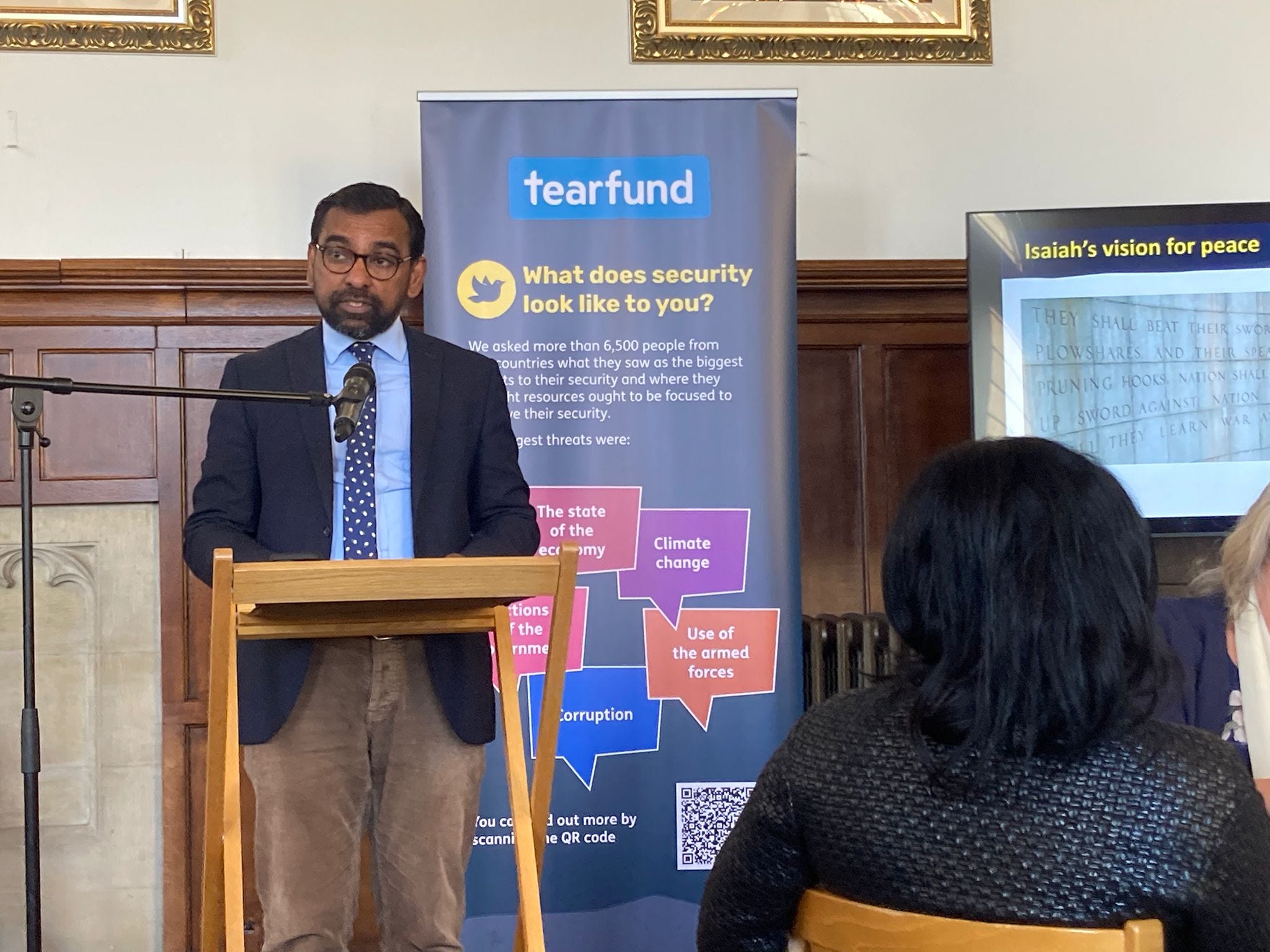
Picture: Tearfund’s practical theologian Philip Powell speaks at the conference on the theme of Christian internationalism’s influence at the birth of the United Nations.
2. How is international political order changing?
In international politics, globalization is the force which is dividing good from evil. What is being unveiled is that politics has rarely been driven by public authorities and national interests but that private interests of greed and status seeking are mixed up in them like the wheat and tares. My recent research looks at how oligarchs and kleptocrats are ensconced in liberal democracies through networks involving professional enablers in financial and legal services including some of the UK’s top banks, law firms, and wealth managers. These actors use the law to protect the worlds elites.
For example, the first two decades of this century, these professionals enabled the purchase of over £1 billion of residential property in London – much of which is in walking distance of Lambeth Palace – for the leaders of Kazakhstan and Azerbaijan and their key cronies in. The foreign policies of these two countries are as much about protecting the elite’s business interests and eliminating rivals as they are the national interest. These are not exceptions but exemplars of normal politics. To take another example, 30% of Indian MPs – that’s in what is often called the world’s largest democracy – face or have been convicted of serious criminal charges. Studies across the world show the increasing volume of political leaders which are either billionaires or criminals or both.
International relations scholars use terms like neo-feudalism and neo-Royalism to capture this changing nature of the world. Neo-feudalism captures the overlapping political communities of medieval times where ‘sovereignty’ was distributed to multiple authorities secular and spiritual, public and private. Neo-royalism emphasises the importance of elite interests. In an important article in a top IR journal, Stacey Goddard and Abraham Newman (2025: 514) define neo-Royalist international order as, “an international system structured by a small group of hyper-elites who use modern economic and military interdependencies to extract material and status resources for themselves”.
But arguably both concepts fail to capture quite how globalization has changed world order. There are three powerful vectors of change that have been apparent since the mid-twentieth century and grew under the so-called liberal international order. They are financial, technological, and cultural. First, notwithstanding the tariffs partially imposed by the man-child in the White House, the economy is profoundly global due to financial globalization which has deepened the divide between elites and masses as it has allowed the return on capital to vastly increase, to be hidden, and to be offshored. Second, technological change with the advent of communications tech such as the internet, generative AI, cryptography, and quantum computing has established new battle lines between the owners of the intellectual property and the users of the services. Third, cultural divides are emerging between those who cling to territorialised or traditional identities and those whose gender identities and solidarities are the product of global trends.
Contrary to naïve statements such as that of Keir Starmer last year that “globalization is over”, global trends and cross-border connections are becoming more apparent. While these trends have new features, emergent from the 1960s/70s, they unveil a deeper historical trend and global consistency: power is captured by elites but limited by effective resistance from the masses.
3. How do we practice security & build peace in apocalyptic & global times?
So far, we have proceeded in quite general terms, but what does this all mean for the practice of security and peacemaking which is the focus of today’s meeting. In Christian theology, peace (shalom) is a central and normative concept. Security is barely considered. In 2024, I published a book that sought to revive the analysis of international security in evangelical political theology. In short, the bible has a lot to tell us about how we become more or less secure in history and about our eschatological security as citizens of heaven. However, Augustinian political theology, which dominates discussions of security, is insufficiently apocalyptic and thus gives us a static account of when government is legitimate and war is just. By contrast, ecclesio-centrist political theology tends to focus on the future-oriented peace ideally realised by the church on earth and disregards security questions.
Perhaps, on this occasion, there’s value in splitting the difference. I’m with the ecclesio-centrists that the primary Christian political category is the Kingdom of God and with the Augustinians that this kingdom is entangled with the world and can only achieve so much in history. Insofar as the church is understood as comingled with rather than apart from the world, as a complex coalition of two and half billion seen Christians and perhaps more in the unseen church, it has far greater reach than any state or empire in history. In terms of security – which always concerns who is to be secure, from what, and for what – we can identify three practical goals for the church.
First, radical inclusion determines who is to be made secure. Unlike in any temporal political community, the church seeks the security of the other, the putative enemy or stranger. Directly, it administers to asylum seekers, refugees, and economic migrants. Indirectly, it calls upon the state to recognise and include them. The vast increase in the number of migrants, and the leading role of the church in welcoming them, is the foundation of security after Christendom and the basis for the globalisation of the church through migration rather than mission.
Second, the church practises nonviolent protection. Academic evidence shows that struggles for rights and justice are always more effective when nonviolent. Research published in our book series Spaces of Peace, Security and Development show that unarmed civilian protection (also known as “accompaniment”) in places of armed conflict saves lives. What nonviolence does not do is defeat an invader such as Russia or win a war of conquest. These tragedies cannot be reversed by nonviolence but recovery from them will not be determined not by the military but by civil action.
Third, the church practices abundant provision. Bucking the logic of the market, the tithing of money and time generates enormous ecclesial capacity to build communities of sharing. This is why the most effective action to address poverty or reduce consumption often begins locally in the church and in partnership with civil society. In comparison, secular international aid is often grossly wasteful. Effective inter-church partnerships are abundant in the goods and services they produce.
In lieu of a conclusion: What does this look like in Ukraine?
I recently returned from a week in Ukraine with Dnipro Hope Mission, a UK based charity which supports Ukrainian pastors and team leaders. It was a time of listening and learning. There I saw evidence of all three of these principles being pursued. Radical inclusion takes the form of the integration of Ukrainian- and Russian-speaking Ukrainian via church-based relief and rehabilitations in a country long divided between West and East. Nonviolent protection takes place through solidarity networks within and across churches; one of the projects DHM supports has rescued over 3,000 vulnerable people from the occupied territories. Abundant provision is apparent in the extraordinary capacity of a network of 40 Christian leaders whose ministries are funded by a £300,000 per annum DHM budget. This is a small fraction of the cost of much less effective international aid projects.
But it is also true that the period since the full-scale Rusisan invasion of 2022 has seen the renewal of the Ukrainian state – and that has been supported by church leaders including free church Baptists and Mennonites. Working for the good of the city in which we find ourselves (Jer 29:7), can mean supporting state capacity and integrity. It may even mean supporting that state’s just defence via the production of counter-drone technology and electronic warfare.
Some Christian peacemakers may object that the tasks of the Ukrainian church should be exclusively pacifist, but this understates the complexity of world in which the wheat and the tares are comingled, and rulers do not bear the sword in vain. As the Ukrainian evangelical theologian Taras Dyatlik argues, peacemaking demands presence in the place of armed conflict and the naming of evil.
The task of the global church with respect to Ukraine is not to pass judgment on its warmaking and peacemaking. The task is solidarity which contributes to Ukrainian security. And this makes taking a stance against those parts of the Russian church – from Orthodox to Evangelical - who have backed the Kremlin’s invasion. Just as the Barmen declaration held the German church to account, so too do Russian Orthodox Civilizationism and its Western evangelical backers need to be held to account.
To that end the Orthodox declaration on the “Russian World” (Russkii Mir) Teaching and the statement of solidarity with that declaration in the Western church which were launched four years ago are both deeply political acts. Forgiveness of Russia cannot take place without repentance by Russia. Such declarations provide the basis for the healing of divide in the global church and the local church’s modelling of new ways of being political community.
Thank you John for joining us and for sharing such rich and stimulating fare. I am sure that all there will be reflecting deeply on what you shared.