
Five Things I Learnt From a Week in Ukraine
War is devastating but also transformative. The Ukrainian church is building peace amidst the ruins. The global church must continue to stand with them.

Do not fret because of those who are evil or be envious of those who do wrong;
for like the grass they will soon wither, like green plants they will soon die away.Psalm 37:1-2
In early March, I spent a week in Ukraine with Dnipro Hope Mission (DHM), an extraordinary Christian charity based in the UK which supports around 40 Ukrainian partners and their projects across Ukraine including on the frontline. It was at once both demanding and enriching, joyous and sad.
The first half of the week was spent listening to pastors, military chaplains, and team leaders of DHM at a retreat in a small town in the Zakarpattia region. We were mainly in listening and praying mode. I led morning prayer on Psalm 37 which calls us not to fret for, even when they appear to succeed (v.7), the enemy will “wither” (v.2) and “be destroyed” (v.9); fretting “leads only to evil” (v.8).
The extraordinary people I heard from were not fretting. They were focused and convinced of the God-given purpose of their work. Moreover, the withering of Russia’s war has long been apparent. But many were saddened and burdened by the loss of their friends and relatives and the damage done to their country. Some were visibly traumatised.
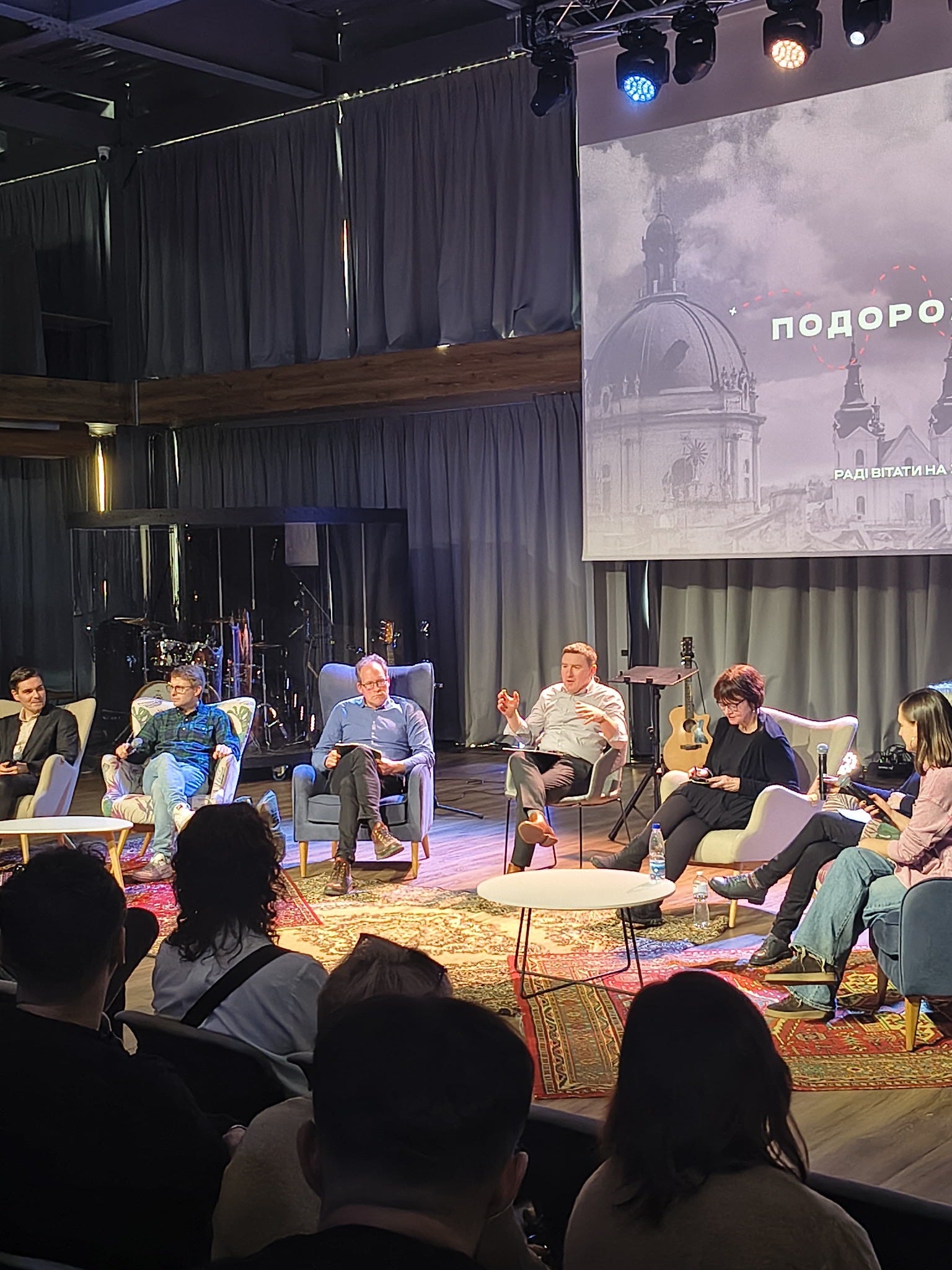
Photo: a panel at the Ukrainian Baptist Theological Seminary, March 2026
The second half of the week was spent in the city of Lviv where we participated in teaching at the Ukrainian Baptist Theological Seminary and a symposium on “How to respond to evil” at the Ukrainian Catholic University. Taras Dyatlik’s talk was particularly striking for its emphasis on the importance of presence over preaching in the church’s response to the war.
This was a common theme. Denis Gorenkov from Kyiv noted in his reflection:
From time to time, international organizations and Christian groups come to Ukraine to speak about resilience. They organize conferences on trauma, seminars about psychological endurance, and workshops on recovery.
Much of this work is sincere and well-intentioned.
But sometimes it creates a strange moment.
People who spend most of their lives outside the reality of war arrive to teach resilience to those who have been living under missile attacks for years.
At moments like this, one almost feels tempted to respond: Thank you for the advice.
But perhaps what we need most right now is not an explanation of resilience.
Perhaps what we need is presence.
I am still processing the events of the week. There are five things which I’m wrestling with in my thoughts and prayers.
1. The human cost of Russia’s war will be felt for decades to come
On one level, this is blindingly obvious. But Ukrainians feel it very deeply. They see the trauma brought home by troops and those under attack. They worry about the women and children who have gone overseas and may not return any time soon. They think about the broken relationships with Russian Orthodox and evangelicals who have baptised the war as a righteous act for Slavic civilisation. The necessary process of Russian Christian repentance, the transnationalisation of the Ukrainian nation, and the treatment of PTSD will play out over decades.
2. The humanitarian response of the Ukrainian church is extraordinary
DHM has a budget of £300,000 per year which supports part but not all of the work of the 40+ partners. This is pocket change for major donor-funded projects that achieve far less than the DHM team. Thousands of persons have been rescued from the frontlines, tens of thousands of refugees have received assistance, and a vast array of projects for returning soldiers, widows, and children are ongoing. Many of these are creative and innovative including one project in Uzhhorod run by a gifted young woman called Margarita which uses animal therapy, as well as art and music therapy, with orphans, children and families. All these projects are Ukrainian designed, not shaped by the fads and priorities of an external donor.
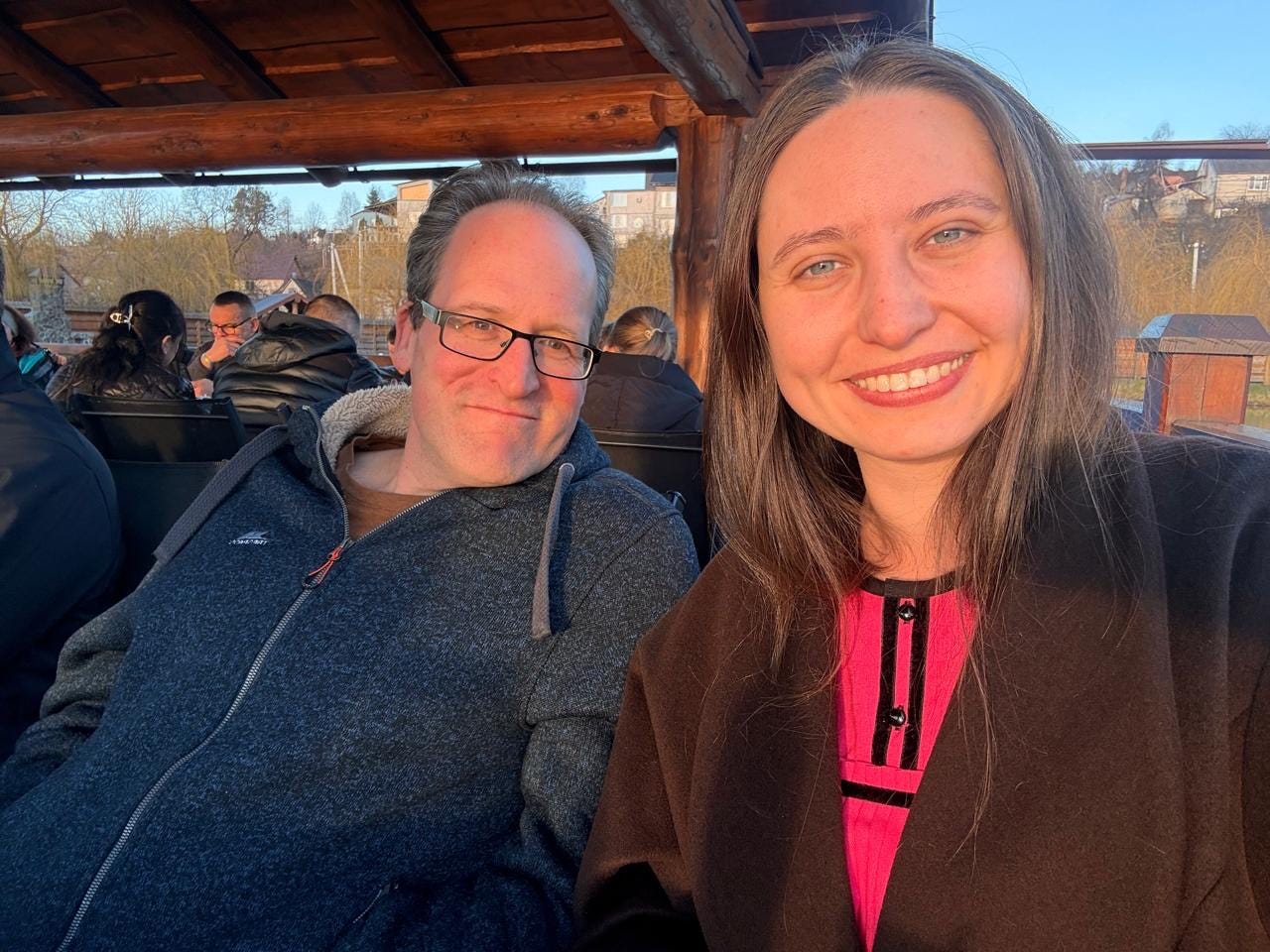
Photo: with Margarita, leader of the Equillibrium project, Uzhhorod
3. Ukrainian theological and ethical insight has been enriched by the war
This may seem odd but just as Dietrich Bonhoeffer’s insights were forged in his resistance to Nazi rule so too have Ukrainians learnt from the criminal invasion of their neighbour. Perhaps the greatest insight here is that while biblical truth is in a prfound sense timeless and universal, theological claims are not. Our theology is necessarily situated in place and time.
After the Holocaust, great German theologians like Moltmann, Metz and Sölle distanced themselves from the state and warfare. Reacting to Russia’s invasion, Ukrainian theologians have sought closeness with the national struggle and ministered to their military. Both name the evil, but they do so in quite different ways. These are diverging but equally legitimate responses. Good political theology should not seek objectivity but name and navigate evil as it faces it.
4. National defence is just, but limited in effectiveness
Coming from European Baptist and peace church traditions, many of the DHM pastors and some of the theologians we met have wrestled with the response to war. Liberal pacifism is inadequate and will not prevent the evil of Russia’s war. Joshua Searle, who led our team in Ukraine, has written powerfully on this topic. But the question arises as to what Ukrainian national defence can achieve and what are the legitimate roles of the Ukrainian and international churches in supporting that.
Easy distinctions between just defensive force and unjust offensive force are difficult to maintain; there are plausible ethical arguments for Ukrainian counter-attacking Russia and even assassinating its military leaders (both of which it has done). The Christian contribution to these debates must be about what could happen as well as what should happen. Virtue and consequentialism are not mutually exclusive schools of thought. If such offence was likely to end the war it may be deemed ethical. If it was, war might be just. But history knows of no just wars; the just war tradition merely provides us with crucial guidelines to limit its relative injustice.
The important point here is that armed force does not – contrary to the views of militaristic Christian Zionists and nationalists, such as those cheerleading for the US-Israeli war against Iran – drive history forward eschatologically. War is cyclical, recurrent and tragically repetitive. Military power generates security dilemmas and competitive arms racing. By contrast, the grain of the universe and the character of our Christian eschatology are non-violent. Ukraine will recover from the war and grow to be a more just and peaceful country through civilian (and ecclesial) politics not national defence.
5. The war’s end is not in sight, but peacemaking is ongoing
My time in Ukraine was transformative in so many respects. I am more invested in helping Ukraine, will spend more time praying and visiting in the future, and seek to find more direct ways to support DHM projects. My ideas about war have shifted too and I’m now more convinced than ever that a Christian ethic of defence is needed; I would like to be a constructive friend to Ukrainian theologians and ethicists for whom such an ethic is existential.
But one thing did not change. Since May/June 2022, I have been convinced that the war – like most wars – will not be resolved by the victory of either side over the other.
Nevertheless, Ukrainians are thankfully already making their society more just and they don’t need Russian defeat and its collective repentance, American arms, or European money to do this work (although the first and third of these things at least will be important over the longer run).
This work was visible in the projects of Dnipro Hope Mission and the extraordinary growth and ambitious plans of the Christian educational institutions we visited. It is here where I found hope and a Ukrainian people who were getting on with peace not fretting about war.
As Taras Dyatlik remarked, we are between Good Friday and Easter Sunday. Easter Saturday is a time of both lament for death and suffering and hope for the resurrection of the body and the redemption of the world which is to come. We Westerners often wish to rush through Easter Saturday – or perhaps go shopping or work in the garden. For us, Dyatlik’s words must be heard:
Western Christianity, in particular, is often uncomfortable with lament. Again, forgive me for saying it. We want to move quickly from Friday to Sunday toward resurrection, toward hope, toward what God is doing through this. And God is doing things through this; I believe that. I saw tulips growing in the rubble of Borodyanka in April 2022, after the Russian occupiers left… But you cannot rush through Holy Saturday. The disciples on that day did not know Sunday was coming. They only knew grief. And God did not interrupt that grief with premature comfort. He inhabited it.
Presence and lament are themselves peacemaking ministries.
Now is not the time to fully process the trauma, or the time to forgive Russia, it is time to lament, to be present, and in so doing pursue the Kingdom of God in the city which we are called.
Thank you John. Very moving and disturbing. Thank you for going to Ukraine and sharing your experiences. This weekend we are having a Peace Conference in Herefordshire on the Welsh border. We will be listening to Misha, a Quaker from Georgia, who has been working with Russian young men refusing to fight. We will hear from three of them, their struggles as refugees, their mental health etc. I understand that at least 200,000 young Russian men are deserters, draft evaders and COs. Around 1.2 million or more Russians are casualties from the war. It is more difficult to get Ukrainian figures. Thanks again. Andrew